Can Bagworms Kill a Tree?
Yes, bagworms can kill a tree, especially evergreens such as arborvitae, juniper, cedar, spruce, cypress, and pine. A light infestation may only make a tree look thin, brown, or ragged. A heavy infestation, however, can strip enough foliage to severely stress the plant, and in some cases, kill it. The risk is highest on conifers because they do not recover from defoliation as easily as many broadleaf trees. University of Maryland Extension notes that heavy bagworm infestations, especially on conifers, can kill shrubs and trees, and that bagworms can cause permanent damage to evergreens.
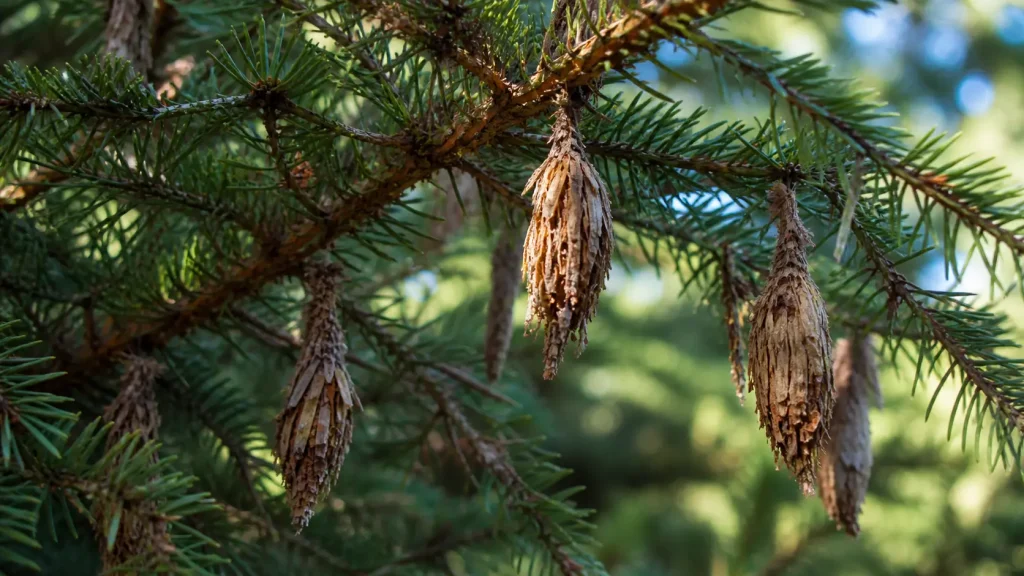
Bagworms are easy to underestimate because they are naturally camouflaged. Their “bags” are made from silk, needles, leaves, and bits of plant material, so they often look like small cones, seed pods, or debris hanging from the branches. By the time many homeowners notice them in late summer, a lot of feeding damage may already be done. Purdue Extension notes that bagworms may go unnoticed until extensive damage has occurred.
What Are Bagworms?
Bagworms are the caterpillar stage of a moth. The pest most often associated with landscape damage is the evergreen bagworm, Thyridopteryx ephemeraeformis. The caterpillar lives inside a portable, spindle-shaped bag that it carries around while feeding. As the caterpillar grows, the bag grows too.
Bagworms feed on many trees and shrubs. Missouri Botanical Garden lists arborvitae, red cedar, and juniper among the most commonly attacked plants, but bagworms can also feed on fir, maple, ginkgo, honeylocust, spruce, pine, sycamore, oak, willow, hemlock, and many others.
How Bagworms Damage Trees
Bagworms damage trees by eating the foliage. Young bagworms may create small holes or “windowpane” feeding marks, but older caterpillars can consume entire needles or leaves. Over time, this causes thinning, browning, bare branches, and sometimes complete defoliation. University of Kentucky Entomology notes that bagworms cause defoliation, canopy thinning, and bronzing on evergreens.
The damage is more serious on evergreens than on deciduous trees. A deciduous tree may be able to push out new leaves after a defoliation event, especially if it is otherwise healthy. An evergreen that loses large sections of needles often cannot simply replace them in the same way. Once the inner or lower portions of an arborvitae, juniper, cedar, or cypress turn brown and bare, those areas may stay bare.
Why Bagworms Can Kill Evergreens
Evergreens depend on their foliage year-round to produce energy. When bagworms strip needles from the plant, the tree loses a major part of its ability to photosynthesize. If the infestation is severe enough, the plant may not have the energy reserves to recover.
A tree is more likely to die from bagworms when:
- The infestation is heavy.
- The tree is small or newly planted.
- The tree is already stressed by drought, heat, poor soil, compacted roots, or disease.
- The same tree is attacked year after year.
- The tree is an evergreen such as arborvitae, juniper, cedar, spruce, or pine.
- The damage is not noticed until late summer.
Missouri Botanical Garden notes that bagworms can partially defoliate plants, weaken them, make them unsightly, and in some cases cause complete defoliation.
Signs You Have Bagworms
The clearest sign is the presence of small hanging bags on branches. These bags may be brown, tan, gray, or greenish depending on the plant material used to build them. They are often 1 to 2 inches long by late summer and may look like tiny ornaments hanging from the tree.
Other signs include:
- Browning branch tips.
- Thin or patchy foliage.
- Bare spots on arborvitae, juniper, cedar, or cypress.
- Small bags moving slowly on the plant in spring or early summer.
- Dead-looking sections on otherwise green shrubs.
- Heavy clusters of bags hanging from twigs.
- Increased damage during July and August.
Early infestations are easy to miss because young bagworms and their bags are tiny. University of Maryland Extension notes that bagworms are often not detected by untrained observers until August, after serious damage has already occurred.
Bagworm Life Cycle: Why Timing Matters
Bagworms overwinter as eggs inside old bags attached to branches. In spring, the eggs hatch and tiny caterpillars emerge. These young caterpillars immediately begin feeding and building their own protective bags. University of Maryland Extension notes that females can lay 200 to 1,000 eggs inside a bag, and those eggs remain there until the following spring.
This is why one missed bag can become a much larger problem the next year. Purdue Extension states that each female bag can produce over 1,000 bagworms.
The best control window is when the caterpillars are young and actively feeding. In Texas landscapes, Texas A&M AgriLife’s Landscape IPM guidance recommends applying insecticide soon after eggs hatch or while larvae are still small and feeding, with April, May, and June generally being effective treatment months in many areas.
By late summer, control becomes much harder. Purdue Extension notes that once bagworms mature in late August or early September, the bags are about 2 inches long and the insects can no longer be killed effectively by pesticides.
Can a Tree Recover From Bagworm Damage?
It depends on the tree and the severity of the damage.
A lightly damaged tree may recover if bagworms are removed early, the plant is watered properly, and the tree is not otherwise stressed. A deciduous tree that loses some leaves may produce new growth the following season.
An evergreen with large dead or bare sections may not fully recover. Brown, defoliated sections of arborvitae, juniper, cedar, and cypress often remain thin or dead-looking. If most of the canopy has been stripped, the tree may continue declining even after the bagworms are removed.
A tree may be beyond saving if:
- More than half of the evergreen canopy is brown or bare.
- The top leader is dead.
- Multiple major limbs are dead.
- The tree has been heavily defoliated for more than one season.
- Bark is cracking, branches are brittle, or there is little green tissue left.
- The tree fails to push healthy new growth the following spring.
When in doubt, scrape a small section of bark on a branch. If the tissue underneath is green, that branch may still be alive. If it is dry and brown, the branch is likely dead.
How to Get Rid of Bagworms
1. Hand-Pick the Bags
For small trees and shrubs, hand removal is one of the most effective options. Pick the bags off the branches and destroy them. Do not simply toss them on the ground near the tree; eggs inside the bags may still hatch and reinfest the plant. University of Maryland Extension recommends removing bags during fall, winter, or spring before the new generation hatches, then destroying them or throwing them away.
Texas A&M AgriLife also notes that handpicking is the cheapest control method, especially in winter, but the bags should be destroyed or discarded because eggs in bags left on the ground can hatch in spring.
2. Use Bt When Bagworms Are Small
Bt, or Bacillus thuringiensis subsp. kurstaki, is a biological insecticide that targets caterpillars. It works best when bagworms are young and actively feeding. Clemson Cooperative Extension explains that Bt must be eaten by the caterpillar, after which it releases a toxin inside the insect’s gut and kills it within a few days.
Bt is not a magic fix for large late-season bagworms. It is most useful in late spring or early summer while the larvae are still small.
3. Consider Spinosad, Neem, or Other Labeled Products
For early infestations, biorational options such as Bt, neem, or spinosad may help manage bagworm populations. University of Kentucky Entomology notes that management is most successful when infestations are caught early in May or June, while late-season infestations may require stronger products that may only limit damage rather than eliminate the population.
Always read and follow the pesticide label. The label determines where the product can be used, how much to apply, how often to apply it, and what safety precautions are required.
4. Spray Thoroughly
Bagworms are protected inside their bags, so coverage matters. The spray needs to reach the foliage they are feeding on. Texas A&M AgriLife recommends using spray equipment that provides complete coverage of all foliage and hiring a professional if the tree is too tall or you do not have adequate equipment.
5. Inspect Again Next Season
Bagworms often return if eggs were missed. After removing or treating them, inspect the same plants again the following spring. Pay special attention to arborvitae, juniper, cedar, cypress, spruce, and pine.
When Should You Treat Bagworms?
The best time to treat bagworms is late spring to early summer, when the eggs have hatched and the caterpillars are still small. In warmer climates such as Texas, it is smart to begin checking susceptible plants in spring and continue monitoring into early summer. Texas A&M AgriLife recommends timing treatment soon after egg hatch or while larvae are small and feeding.
A practical homeowner schedule looks like this:
Fall through early spring:
Inspect trees and shrubs for old bags. Hand-pick and destroy them before eggs hatch.
Late spring:
Watch for tiny moving bags and early feeding damage. This is the best time for Bt or other lower-impact controls.
Early summer:
Treat active infestations while larvae are still small.
Late summer:
Large bags are harder to control. Hand removal may still reduce next year’s population, but sprays are often less effective.
Winter:
Inspect again and remove any remaining bags.
How to Prevent Bagworms From Coming Back
Prevention is mostly about inspection and early action. Bagworms are much easier to manage before they become large and numerous.
To reduce future infestations:
- Inspect vulnerable evergreens every spring.
- Remove old bags before May or early June.
- Keep trees healthy with proper watering and mulch.
- Avoid drought stress when possible.
- Do not over-fertilize stressed trees.
- Preserve beneficial insects by avoiding unnecessary broad-spectrum insecticides.
- Check nearby shrubs and neighboring trees, since young bagworms can spread by “ballooning” on silk threads carried by wind.
Final Answer: Can Bagworms Kill a Tree?
Yes. Bagworms can absolutely kill a tree, especially evergreen trees and shrubs like arborvitae, juniper, cedar, cypress, spruce, and pine. A few bagworms may only cause cosmetic damage, but a heavy infestation can strip foliage, weaken the plant, create permanent bare spots, and eventually kill the tree.
The key is timing. Remove bags in fall, winter, or early spring before eggs hatch. If you see young bagworms feeding in late spring or early summer, treat them quickly while they are still small. Once the bags are large and the tree is already turning brown, control becomes more difficult, and the damage may already be permanent.