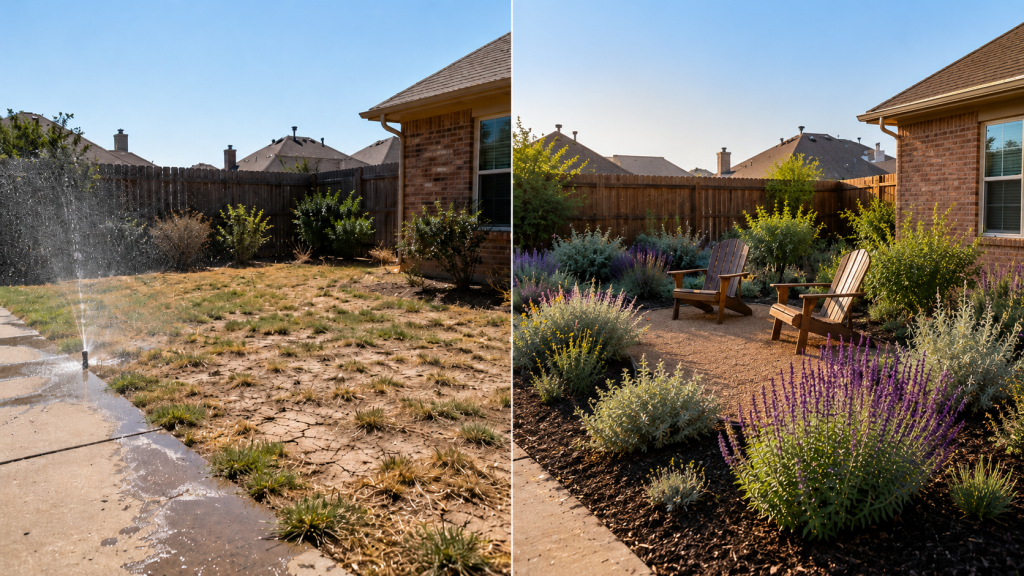
Every Dallas homeowner has had the moment. You stand at the back door in July, hose in hand, watching another patch of St. Augustine crisp to straw while the water bill climbs. You wonder whether the yard you inherited is actually the yard you’d choose.
The good news: it doesn’t have to be this way. The better news: the DFW landscaping market has moved decisively toward practical, resilient yards that hold up through August and invite you outside in October. Here’s how to tell whether your yard is working against you — and what to do about it.
The DFW Reality Check
A yard that works in Dallas has to answer to four forces no amount of big-box-store optimism can negotiate away:
Clay soil. Our heavy, alkaline clay drains poorly in wet months and sets up like concrete in dry ones. Plants that didn’t evolve for it struggle. Plants that did — our native and adapted species — thrive in it without amendment marathons.
Brutal heat. A string of 100-degree days isn’t an anomaly here; it’s August. A yard built around thirsty turf and non-native ornamentals fights this reality every year. A yard built around heat-adapted plants coasts through it.
Water reality. Water restrictions are now a permanent feature of DFW summers, not an occasional inconvenience. A yard designed for twice-weekly deep watering on native beds uses a fraction of what a turf-heavy yard demands daily.
Usability. A pretty yard you can’t use is a postcard, not a backyard. Shade, seating, paths, and functional space matter as much as what’s planted.
The Self-Audit: Six Questions
Walk your yard with these six questions. You’ll know by the end whether it’s working for you or against you.
1. How much of your yard is mowed turf?
Turf isn’t the enemy. But turf that no one walks on, plays on, or uses is just a maintenance liability with a water habit. In most Dallas yards, 30 to 50 percent of the turf area is purely ornamental — mowed, watered, and fertilized for an audience of zero.
What to do: Identify the turf you actually use. The rest is candidate space for native beds, mulch paths, or expanded planting areas. You’ll mow less, water less, and reclaim Saturday mornings.
2. What happens when it hits 102 degrees?
If the answer involves daily panic-watering, your plant palette is working against the climate instead of with it. Heat-adapted plants — Texas sage, salvia greggii, esperanza, turk’s cap, blackfoot daisy — don’t flinch at triple digits. They’re built for this.
What to do: Audit your beds for heat performance. Flag anything that wilts daily or needs supplemental water on top of your irrigation schedule. Those are replacement candidates.
3. What’s your mulch situation?
Bare soil in Dallas is a triple loss: it bakes in the sun, crusts over so water runs off instead of soaking in, and invites weeds that compete with what you actually planted. A solid mulch layer — two to three inches of hardwood or native mulch — changes the math entirely.
What to do: Check every bed. If you can see soil, you need mulch. A spring or fall mulch refresh is the single highest-leverage maintenance move a Dallas homeowner can make: cooler roots, slower evaporation, fewer weeds, better soil structure over time.
4. Does your yard hold water or shed it?
Clay soil plus Dallas’s feast-or-famine rain pattern means water either pools or sheets away. If you’ve got standing water after a storm, or if beds sit higher than surrounding hardscape so irrigation runs into the street, the yard is working against you on both ends.
What to do: Watch your yard during the next real rain. Note where water collects and where it escapes. Berms, swales, and rain gardens planted with water-tolerant natives turn drainage problems into planting opportunities.
5. Could you host people here this weekend?
Be honest. If the answer is no — too hot, too buggy, no shade, no place to sit — the yard isn’t pulling its weight as usable square footage. In DFW, October through May is prime outdoor season. A yard that goes unused for eight good-weather months because it’s designed for looking rather than living is a missed opportunity.
What to do: Think about one zone — a corner, a side yard, a patch near the patio — where shade, seating, and low-water planting could create an actual outdoor room. Start there.
6. Six months from now, will this be easier or harder?
This is the question that separates a good landscaping decision from an expensive impulse. Will that new bed reduce mowing? Will those plants survive on rainfall once established? Will the mulch mean less weeding? Every choice should tilt the answer toward easier.
What the Smartest DFW Yards Are Doing Now
The trend line in Dallas landscaping is unmistakable. Homeowners who are thinking ahead are making four moves:
Native and adapted planting beds that replace non-functional turf. These beds, once established, run on rainfall and occasional deep watering rather than daily irrigation. Plant selection matters enormously here — the right plant in the right spot with the right soil contact is the difference between a bed that coasts and a bed that constantly needs intervention.
Reduced thirsty turf. Not eliminated — reduced. Turf stays where it’s used and goes where it isn’t. The square footage shifts into planted beds, mulched areas, or hardscape that actually serves how the household lives outside.
Mulch — and more of it. A mulch refresh once or twice a year keeps roots cool, holds moisture in the soil profile, suppresses weeds, and breaks down into organic matter that gradually improves clay soil structure. It’s unglamorous, inexpensive, and it works.
Lower-water beds designed in layers. Canopy trees for shade, understory shrubs for structure, perennials and groundcovers for coverage. A layered bed shades its own soil, reduces evaporation, and needs less from you over time.
The Takeaway for Your Yard
Practical, resilient yards are the new standard in DFW — not just pretty yards, but yards that hold up, use less, and give more back. If yours isn’t there yet, the path isn’t a full teardown. It’s a series of deliberate choices about what stays, what gets replaced, and what gets redesigned to work with the climate instead of against it.
Ask yourself: six months from now, will your yard be easier to maintain, more water-smart, and more usable than it is today? If the answer isn’t an easy yes, it’s worth a conversation.
Read our full guide to native and adapted beds, or reach out and ask us what makes sense for your yard — front-yard refresh, plant selection, mulch plan, or a full re-think. We’ll tell you straight what’s worth doing and what isn’t.