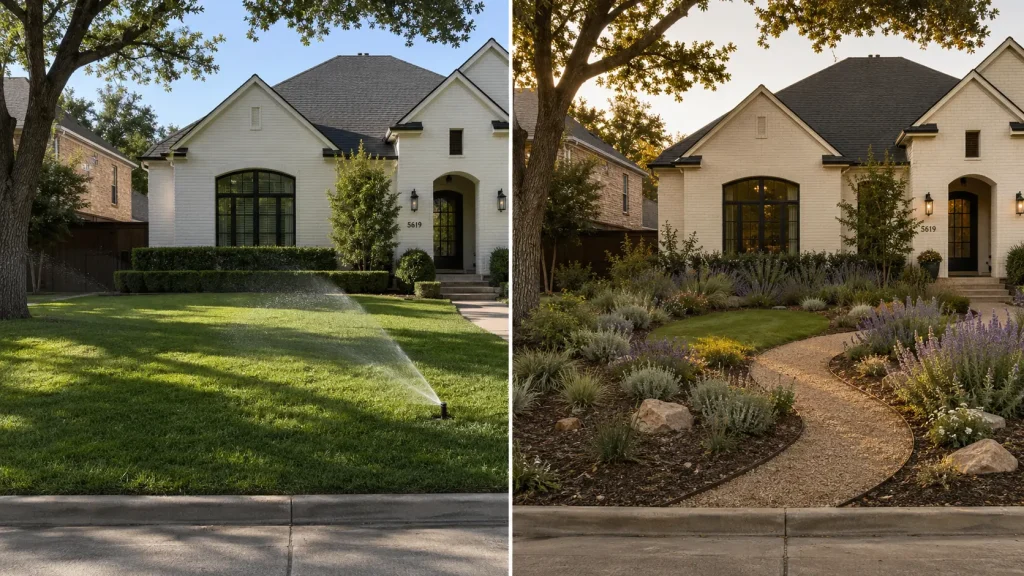
If you spend enough time talking to homeowners across Dallas, Garland, Richardson, and the northern suburbs, a pattern emerges that has nothing to do with what’s in the glossy landscape brochures.
Homeowners aren’t asking for pretty yards anymore. They’re asking for yards that don’t fight back.
The Shift
Three or four years ago, the typical call started with curb appeal — make it look like the magazine, match the neighbor’s hedges, get the lawn striped. Those calls still come. But the volume has shifted toward something else entirely: I’m tired of watering something that dies anyway. I want less mowing. I want to actually use my backyard in October. What should I do?
That shift isn’t anecdotal. Across DFW, the landscaping market is moving decisively toward practical, resilient yards. The top-tier trend line is clear:
- Native and adapted planting replacing non-functional turf.
- Reduced thirsty grass — not eliminated, but cut back to what the household actually walks on.
- Mulch — more of it, refreshed regularly, doing the unglamorous work of cooling roots and holding moisture.
- Lower-water beds designed in layers that shade their own soil and need less from the irrigation clock.
What Homeowners Are Actually Buying
Strip away the plant names and square-footage estimates, and here’s what people are really purchasing when they make these changes:
Time back. Less mowing. Less weeding. Less standing in the heat with a hose and a theory.
Predictable water bills. A native bed on a twice-weekly deep soak uses a fraction of what a turf-heavy yard demands during restrictions.
A yard that doesn’t quit in August. Heat-adapted plants — salvias, sages, esperanza, turk’s cap — don’t flinch at 102 degrees. That’s not a feature. That’s the baseline.
Fall through spring outside. October through May is prime outdoor season in DFW. A yard that’s usable during those months — shade, seating, space to host — pays back every dollar spent on the redesign.
The One Question That Cuts Through the Noise
Before you spend anything, ask this: Six months from now, will the yard be easier to maintain, more water-smart, and more usable than it is today?
If the answer isn’t an easy yes, reconsider the plan. The best landscaping decisions in this market tilt everything toward simpler. Less input, less intervention, more return.
That’s not a compromise. That’s the point.
This is a local market observation, not a how-to guide. If you want the practical steps — what to plant, what to mulch, what to tear out, and in what order — read our full guide to native and adapted beds, or reach out. We’ll walk your yard with you and tell you straight what makes sense.