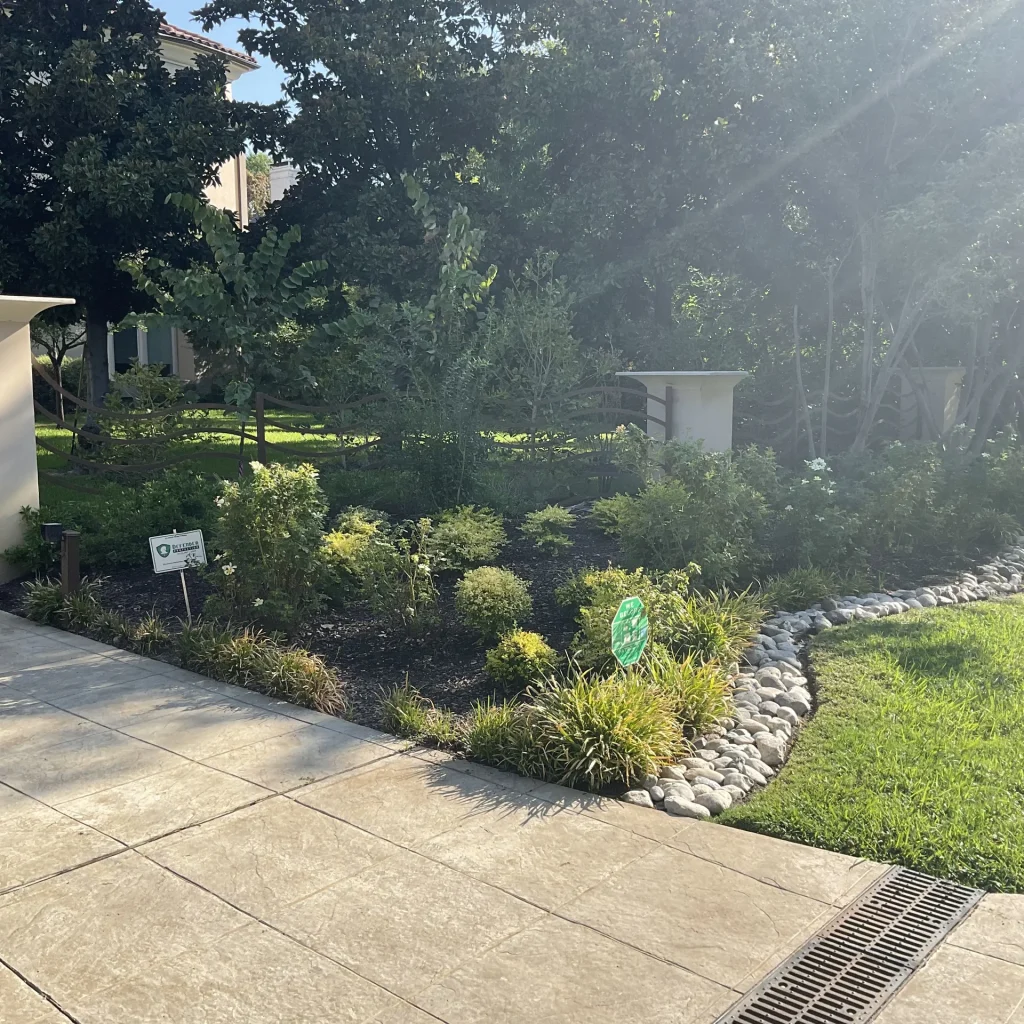
Water is the most expensive input in a Texas landscape — and the most restricted. With DFW municipalities enforcing twice-weekly watering limits during summer months, every drop counts. Choosing between a sprinkler system and drip irrigation isn’t just about convenience; it’s about keeping your landscape alive within the rules. Here’s how to decide which system — or combination — is right for your property.
The Core Difference
Sprinkler systems spray water through the air to cover large areas. They’re ideal for lawns and large, open spaces.
Drip irrigation delivers water directly to the root zone through a network of tubes and emitters. It’s ideal for flower beds, vegetable gardens, and individual plants.
Sprinkler Systems: The Lawn Standard
Best For
- Large lawn areas (Bermuda, St. Augustine, Zoysia)
- Open, unobstructed spaces
- Properties with uniform sun exposure
- Homeowners who want automated, whole-yard coverage
Pros
- Complete coverage — one system waters the entire lawn
- Automated — set it and forget it with a smart controller
- Visible operation — you can see if a zone is working
- Fertigation capable — some systems can inject liquid fertilizer
- Familiar technology — easy to find repair parts and service
Cons
- 30–50% water waste from evaporation, wind drift, and overspray
- Promotes fungal disease — wet foliage is a breeding ground for brown patch and gray leaf spot
- Uneven coverage — edges and corners often get less water
- Higher pressure requirements — needs 40–65 PSI for proper operation
- More expensive to repair — buried pipes and valves can be hard to access
DFW-Specific Considerations
- Wind — DFW’s spring winds (20–30 mph gusts) blow sprinkler water sideways, wasting 30%+ of what comes out
- Evaporation — on a 100°F July afternoon, up to 50% of sprinkler water evaporates before hitting the ground
- Water restrictions — most DFW cities limit sprinkler use to 1–2 days per week; you may not be able to apply enough water in those windows during peak heat
- Clay soil — DFW’s clay absorbs water slowly; sprinklers often cause runoff before the water penetrates
Drip Irrigation: Precision Watering
Best For
- Flower beds, shrub borders, and foundation plantings
- Vegetable gardens and raised beds
- Sloped areas (no runoff)
- Narrow strips and odd-shaped areas
- Properties with mixed planting (turf + beds)
Pros
- 90%+ efficiency — water goes exactly where it’s needed
- Zero overspray — no water on walkways, driveways, or siding
- Reduced disease — dry foliage means fewer fungal problems
- Works with low pressure — operates at 15–30 PSI
- Compatible with water restrictions — drip is often exempt from watering day limits
- Easy to expand — add more tubing and emitters as your garden grows
Cons
- Not suitable for lawns — can’t cover large turf areas effectively
- Visible tubing — can be unsightly if not hidden under mulch
- Clog-prone — emitters need filtration and occasional cleaning
- Harder to inspect — leaks may go unnoticed until plants show stress
- Higher initial cost per square foot for small areas
DFW-Specific Considerations
- Clay soil — drip irrigation is ideal for clay because it applies water slowly, allowing it to soak in rather than run off
- Heat — buried drip lines stay cool, reducing water loss to evaporation
- Water restrictions — many DFW cities allow drip irrigation on any day, even during Stage 3 restrictions
- Fire ants — they love nesting in drip tubing; use ant control around drip zones
Head-to-Head Comparison
| Factor | Sprinkler System | Drip Irrigation |
| ——– | —————– | —————– |
| Water efficiency | 50–70% | 90–95% |
| Best for | Lawns, large areas | Beds, gardens, individual plants |
| Installation cost | $2,500–$5,000 (1/4 acre) | $500–$2,000 (beds only) |
| Annual water cost (1/4 acre) | $600–$1,200 | $200–$500 |
| Maintenance | Moderate (heads, valves, pipes) | Low (emitters, filters) |
| Lifespan | 15–20 years | 10–15 years (tubing) |
| Wind loss | 20–40% | 0% |
| Disease risk | Higher | Lower |
| Automation | Excellent | Excellent (with timer) |
The Hybrid Approach: Best of Both Worlds
For most DFW properties, the optimal solution is a hybrid system:
- Sprinklers for the lawn — rotary or rotor heads for large turf areas
- Drip irrigation for beds — 1/2-inch mainline tubing with individual emitters for shrubs and flowers
- Smart controller — a Wi-Fi-enabled controller (Rachio, Orbit B-hyve, Hunter Hydrawise) that adjusts watering based on weather, soil moisture, and local restrictions
Why Hybrid Works in DFW
A typical DFW property has 60% lawn and 40% beds. Using sprinklers for the lawn and drip for the beds:
- Saves 30–50% on water compared to all-sprinkler
- Keeps the lawn green with efficient rotor heads
- Protects foundation plants with precise drip watering
- Complies with restrictions — water the lawn on allowed days, run drip any day
- Reduces disease in beds where St. Augustine and shrubs are prone to fungal issues
Installation Complexity
Sprinkler System Installation
- DIY difficulty: High — requires trenching, pipe sizing, pressure calculations, and electrical work
- Professional cost: $2,500–$5,000 for a typical 1/4-acre lot
- Time: 2–3 days for a professional crew
- Permits: Required in most DFW cities
Drip Irrigation Installation
- DIY difficulty: Low to moderate — basic systems are straightforward
- Professional cost: $500–$2,000 for typical bed areas
- Time: 1 day for a professional crew
- Permits: Usually not required
Smart Controllers: The Game Changer
Modern smart irrigation controllers use local weather data, soil sensors, and flow meters to optimize watering automatically. In DFW, where restrictions change seasonally and rainfall is unpredictable, a smart controller can save 20–40% on water while keeping your landscape healthier.
Top picks for DFW:
- Rachio 3 — best app, easy setup, integrates with Alexa/Google
- Hunter Hydrawise — professional-grade, excellent for large properties
- Orbit B-hyve — budget-friendly, good for DIY installations
Our Recommendation
| Your Property | Best System |
| ————— | ————- |
| Lawn only (no beds) | Sprinkler system with smart controller |
| Beds only (no lawn) | Drip irrigation |
| Lawn + beds (typical DFW home) | Hybrid — sprinklers for turf, drip for beds |
| Vegetable garden | Drip irrigation only |
| Sloped property | Drip irrigation (prevents runoff) |
| Rental property | Drip irrigation (lower cost, less maintenance) |
Ready to Upgrade Your Irrigation?
Whether you need a new sprinkler system, drip irrigation for your garden beds, or a complete hybrid setup, Groundhogs Services designs and installs irrigation systems tailored to DFW’s unique climate and water restrictions.
Call us at (214) 713-1228 or visit groundhogstx.com to schedule a consultation. Let’s make every drop count.