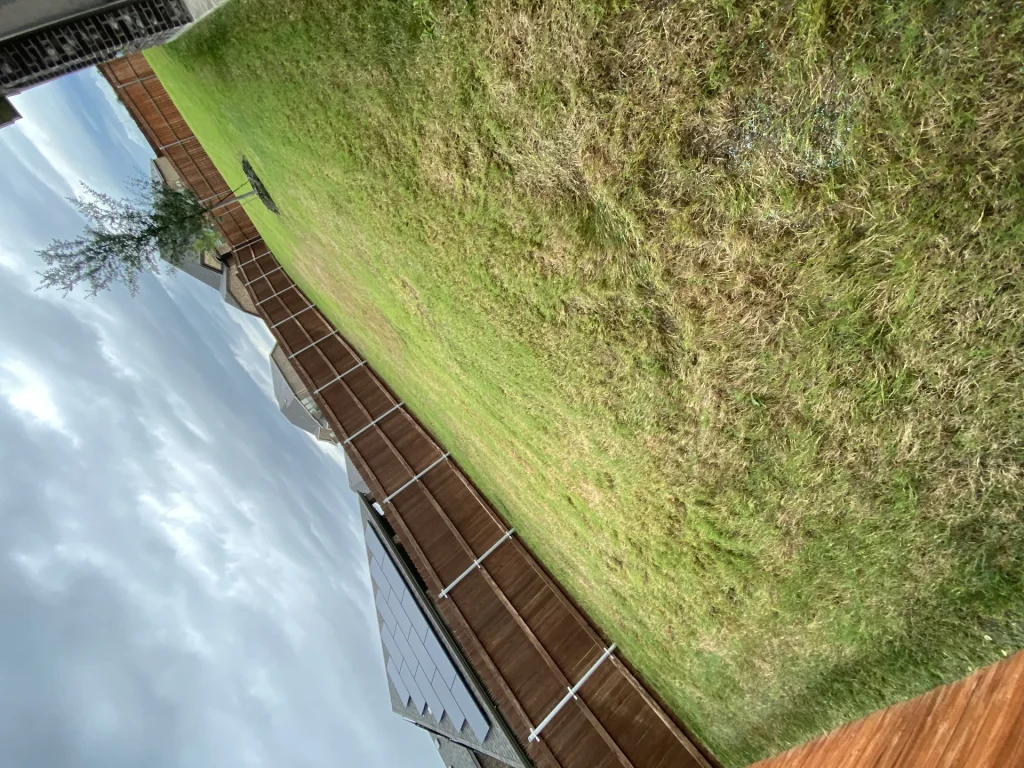
If your DFW property has a slope, you already know the struggle. Every heavy rain sends mud washing across your lawn. The backyard is too steep to use. And that cracking driveway? It’s probably caused by soil movement. A properly designed retaining wall solves all of these problems — but only if it’s built for North Texas clay.
At Groundhogs Services, we’ve engineered and installed retaining walls across Mesquite, Dallas, Garland, and Rockwall. Here’s what you need to know.
When Do You Need a Retaining Wall?
A retaining wall is required when you need to hold back soil at a change in grade. In DFW, common scenarios include:
- Sloped backyards — Terracing a steep lot creates usable flat space for patios, gardens, or play areas
- Driveway cutouts — Preventing soil from sloughing onto the driveway
- Foundation protection — Directing water away from the house on sloped lots
- Erosion control — Stopping gully erosion during spring thunderstorms
- Raised planter beds — Decorative walls that also serve a structural purpose
Types of Retaining Walls
Segmental Retaining Walls (SRW)
These are the most common in DFW — interlocking concrete blocks that stack without mortar. They use a pin-and-grid system for stability.
Pros: $15-$30 per square foot, no mortar required, flexible (handles soil movement), built-in drainage, DIY-friendly for low walls
Cons: Limited height without engineering, visible block face, can bulge if improperly backfilled
Best for: 2-4 foot walls, terraced gardens, residential landscaping
Poured Concrete Walls
Reinforced concrete walls are the strongest option. They’re cast in place with rebar and can hold back significant loads.
Pros: $30-$50 per square foot, extremely strong, can reach 8+ feet, smooth finish, waterproofed easily
Cons: Expensive, requires forms and curing time, rigid (cracks if soil moves), needs engineering for any wall over 4 feet
Best for: Tall walls (4+ feet), commercial applications, foundation-adjacent walls
Natural Stone Walls
Dry-stacked or mortared natural stone walls offer timeless beauty. They blend perfectly with Texas landscapes.
Pros: $25-$60 per square foot, beautiful appearance, natural drainage (dry-stack), blends with native landscape
Cons: Expensive, labor-intensive, limited height for dry-stack, mortar joints can crack in clay soil
Best for: Low garden walls, decorative features, rustic landscapes
Timber Walls
Pressure-treated railroad ties or landscape timbers are the budget option.
Pros: $10-$20 per square foot, quick installation, natural look
Cons: 5-10 year lifespan in DFW (rot, termites), limited to 3 feet height, can bow under pressure, not recommended for structural applications
Best for: Temporary solutions, very low walls, budget-constrained projects
Drainage: The Make-or-Break Detail
More retaining walls fail from poor drainage than from any other cause. Water pressure behind a wall (hydrostatic pressure) can exceed the wall’s design load by 10x.
Every retaining wall needs:
- Perforated drainage pipe — 4-inch corrugated or PVC pipe wrapped in filter fabric, placed at the base of the wall behind the blocks
- Gravel backfill — 12-18 inches of 3/4″ washed gravel behind the wall, extending from the drain pipe to within 6 inches of the top
- Weep holes — If using a solid-face wall (poured concrete or mortared stone), weep holes every 4-6 feet at the base
- Daylight outlet — The drain pipe must exit at the downhill end of the wall. Never dead-end it.
DFW clay soil note: Clay holds water and expands. Without proper drainage, the wall will experience 2-3x the normal hydrostatic pressure. We always over-spec drainage in DFW.
When You Need Engineering
In most DFW municipalities, retaining walls over 4 feet in height require a stamped engineer’s plan. Some cities (Dallas, Plano) require engineering for walls over 3 feet.
Engineering is also required when:
- The wall supports a driveway or structure
- The wall is within 5 feet of a property line
- The wall is within 10 feet of a foundation
- The slope above the wall exceeds 2:1 (horizontal:vertical)
- The wall is in a floodplain
Cost: $500-$2,000 for a residential retaining wall design, depending on complexity.
DFW Clay Soil Challenges
North Texas has some of the most challenging soil in the country. Our clay (primarily the Austin Chalk and Eagle Ford formations) has a plasticity index of 30-60 — meaning it expands and contracts dramatically with moisture changes.
What this means for your retaining wall:
- Base depth — We excavate 12-18 inches below grade for the base, even for 3-foot walls. In clay, the base must sit below the active zone of soil movement.
- Compaction — We compact the base to 95% Standard Proctor density. Anything less and the wall will settle.
- Geogrid reinforcement — For walls over 3 feet, we install geogrid (tensile reinforcement) extending 4-6 feet into the backfill. This ties the wall to the stable soil behind it.
- Flexible construction — Segmental block walls are preferred because they can accommodate minor soil movement without cracking.
Cost per Square Foot
| Wall Type | Materials | Labor | Total (installed) |
|---|---|---|---|
| Timber (2-3 ft) | $5-$8/sq ft | $5-$12/sq ft | $10-$20/sq ft |
| Segmental block (2-4 ft) | $8-$15/sq ft | $7-$15/sq ft | $15-$30/sq ft |
| Natural stone (2-4 ft) | $12-$30/sq ft | $13-$30/sq ft | $25-$60/sq ft |
| Poured concrete (4-8 ft) | $12-$20/sq ft | $18-$30/sq ft | $30-$50/sq ft |
Example: A 50-foot long, 3-foot tall segmental block wall = 150 sq ft × $22/sq ft = approximately $3,300 installed.
Ready to Stabilize Your DFW Slope?
A properly designed retaining wall transforms unusable land into valuable outdoor space. Groundhogs Services handles everything from soil testing and engineering coordination to final stone cap installation. We build walls that hold — literally.
Call (214) 713-1228 or visit groundhogstx.com to schedule a site evaluation.