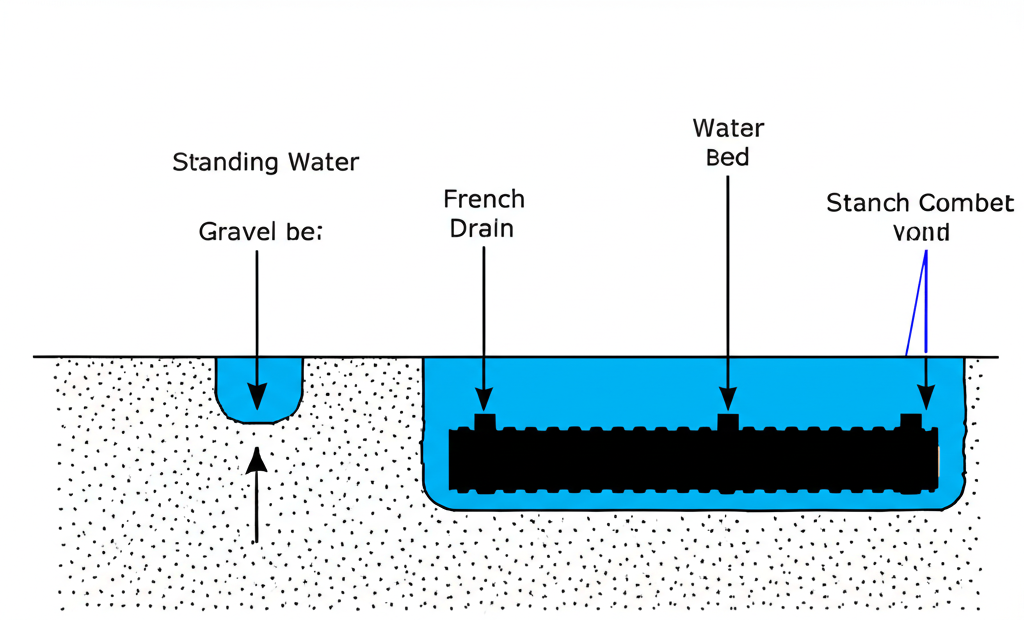
If your North Texas yard turns into a swamp after a heavy spring downpour, or if water pools dangerously close to your concrete slab foundation, installing a subsurface drainage system is not optional. But the most critical decision in any French drain or downspout burial project happens before a single shovel enters the ground: which pipe material are you burying?
Big-box home improvement stores and budget landscape contractors routinely promote 4-inch black corrugated polyethylene pipe. It is cheap, flexible, and easy to roll out into a shallow trench. However, in the expansive clay soils of the Dallas–Fort Worth Metroplex, choosing corrugated tubing over smooth-wall rigid PVC is the single most common reason French drains fail in fewer than three years.
Why North Texas Blackland Prairie Clay Destroys Cheap Drainage
North Texas sits on a geological formation known as the Blackland Prairie, dominated by Houston Black and related clay soils. These soils are famous for their extreme shrink-swell capacity. During wet winter and spring months, the clay absorbs vast amounts of water and expands with tremendous force. During hot, dry Texas summers, it dries out, shrinks, and fissures with deep surface cracks.
This perpetual movement creates two severe mechanical challenges for underground drainage pipes:
- Immense Hydrostatic and Soil Loading: Wet, saturated clay becomes extraordinarily heavy and dense. Thin-walled pipes buried 18 to 24 inches down must endure continuous lateral and downward compression.
- Micro-Fines Silt Migration: Blackland clay is comprised of microscopic mineral particles. Saturated water carries these ultra-fine particles directly through trench gravel and into any subsurface piping.
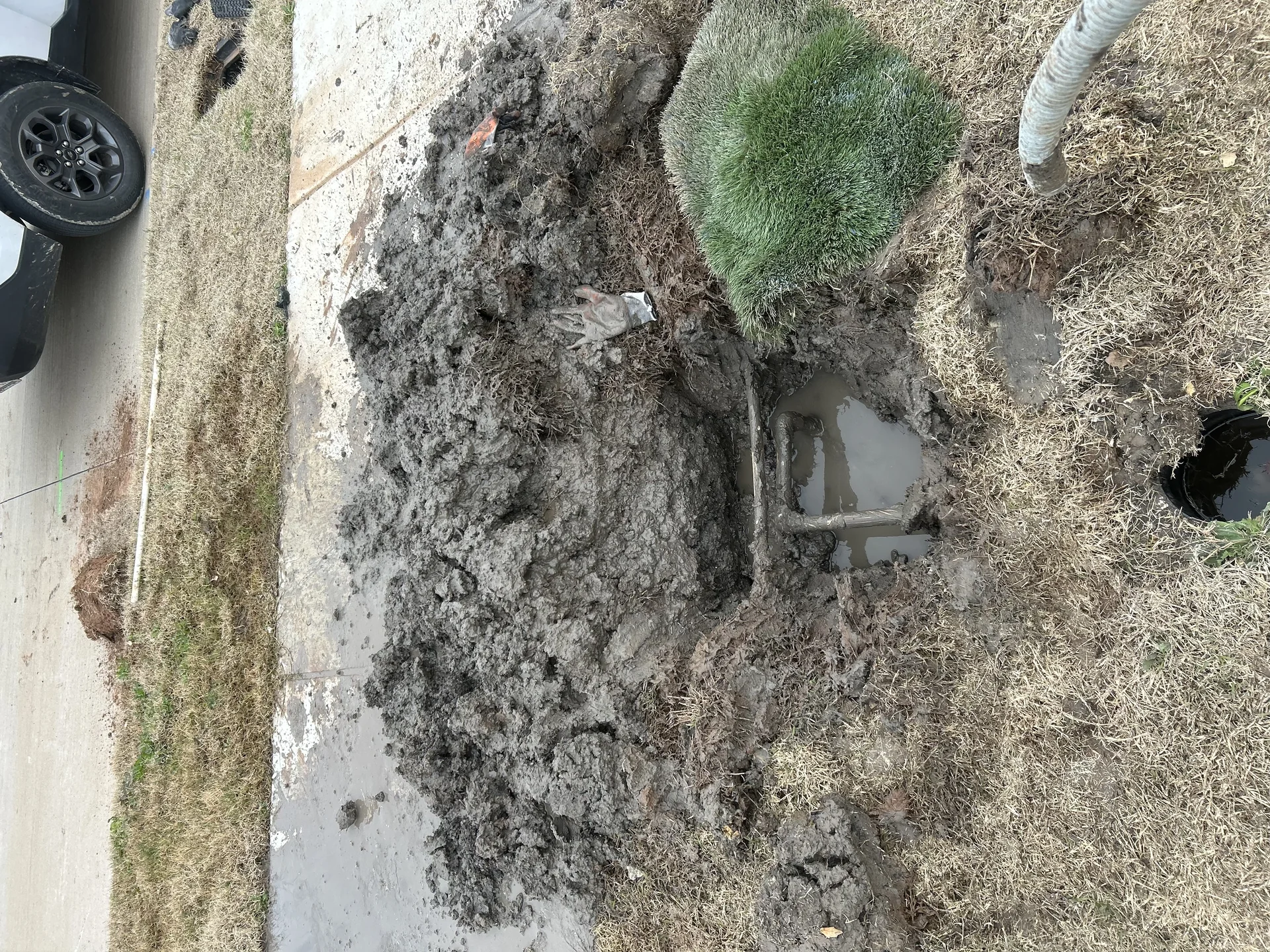
The Corrugated Pipe Trap: Why It Fails in Under 3 Years
Black flexible corrugated pipe (often sold under brand names like ADS single-wall) has internal and external ridges that allow it to bend around corners without elbows. While convenient for quick DIY installations, those ridges represent structural and hydrodynamic failure points in Texas yards:
1. High Friction Coefficient and Sediment Trapping
In fluid dynamics, flow resistance is measured by Manning’s roughness coefficient (n). Corrugated pipe has a roughness rating of approximately n = 0.015 to 0.018, whereas smooth-wall PVC has a rating of n = 0.009 to 0.011. Water moves significantly slower through corrugated pipe. Because water slows down over every internal ridge, suspended clay fines drop out of suspension and settle into the valleys of the corrugations. Over 18 to 36 months, this sediment cakes and hardens, reducing a 4-inch pipe to a 2-inch trickle.
2. Crush Vulnerability Under Wet Clay Weight
Single-wall corrugated pipe relies on surrounding soil compaction for structural integrity. When North Texas clay gets soaked, it loses load-bearing capacity while dramatically increasing in weight. The heavy, expanding clay presses down on the flexible pipe, causing it to deform into an oval or crush completely. Once crushed, water backs up immediately toward the foundation.
3. Root Penetration and Zero Cleanability
Aggressive root systems from common North Texas trees—such as Live Oaks, Cedar Elms, and Crepe Myrtles—instinctively seek out moisture inside corrugated pipe joints and perforations. Once roots enter corrugated tubing, it cannot be cleared. A mechanical rotary drain snake or hydro-jetter will catch on the internal plastic ridges and tear the pipe to pieces. When a corrugated drain clogs, the only remedy is digging up the entire yard and replacing it.
Smooth-Wall Rigid PVC: The Structural Standard
Professional drainage engineering in North Texas demands rigid, smooth-wall PVC pipe. The smooth interior maintains maximum water velocity, allowing stormwater to flush sediment completely out of the pipe before it can settle.
SDR 35 (ASTM D3034) vs. Schedule 40 (ASTM D1785)
When selecting rigid PVC for residential drainage, two primary specifications dominate:
- SDR 35 Sewer & Drain Pipe: Thin-wall relative to Schedule 40, but engineered with a smooth interior and solvent-weld or gasketed bell ends. It provides sufficient pipe stiffness (46 psi minimum) for standard yard foot traffic and flowerbeds while offering exceptional flow velocity.
- Schedule 40 Solid Core PVC: The gold standard for maximum structural strength. Schedule 40 has thick walls that withstand vehicular traffic across driveways, severe root pressure, and the heaviest clay expansion. All fittings are permanently solvent-welded with heavy-duty PVC primer and cement.
Most importantly, a rigid PVC drainage system allows for the installation of surface cleanout risers. If leaves or debris ever accumulate in the line, a professional drain technician can run a camera inspection or hydro-jet the pipe safely without risking structural damage.
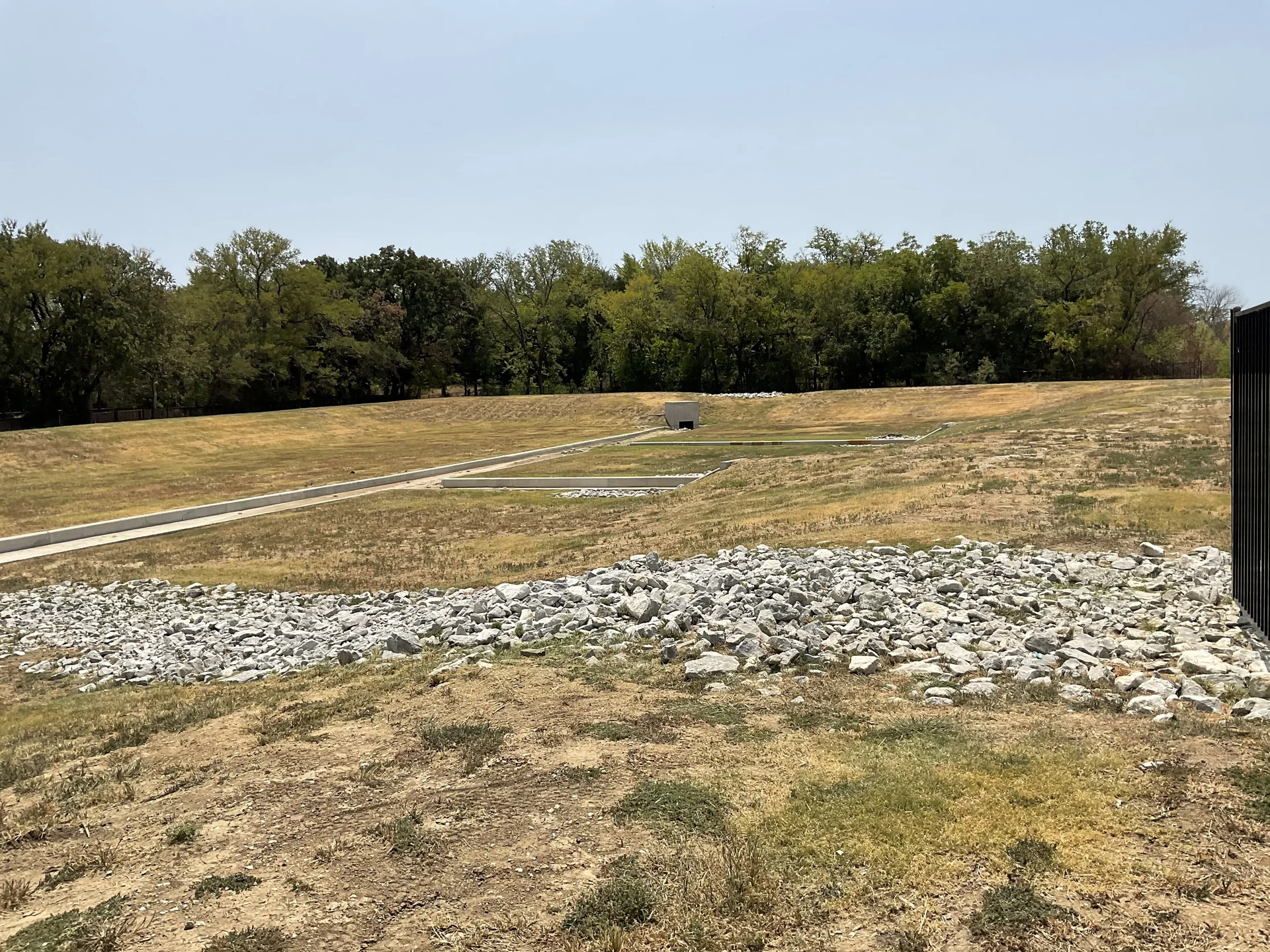
Solid vs. Perforated: Matching Pipe to Drainage Zone
A frequent and costly installation error is using perforated pipe everywhere. In a properly designed residential drainage system, perforated and solid pipes have distinct, non-interchangeable roles:
Perforated Pipe: For Subsurface Groundwater Collection Only
Perforated PVC features drilled holes (typically two or four rows of 1/2-inch holes) positioned downward toward the trench bed. It is installed inside a washed gravel envelope to collect subsurface water that is saturating the soil profile. Never connect gutter downspouts directly into perforated pipe near your foundation. Doing so injects thousands of gallons of roof runoff straight into the ground next to your concrete slab, accelerating foundation settling or heave.
Solid Pipe: For High-Volume Runoff Transportation
Solid-wall PVC has zero perforations. It is used to connect gutter downspouts, catch basins, and area drains, transporting high-volume surface stormwater cleanly across the property to a designated discharge point—such as a street curb, dry creek bed, or pop-up emitter—without losing a single drop into the soil along the way.
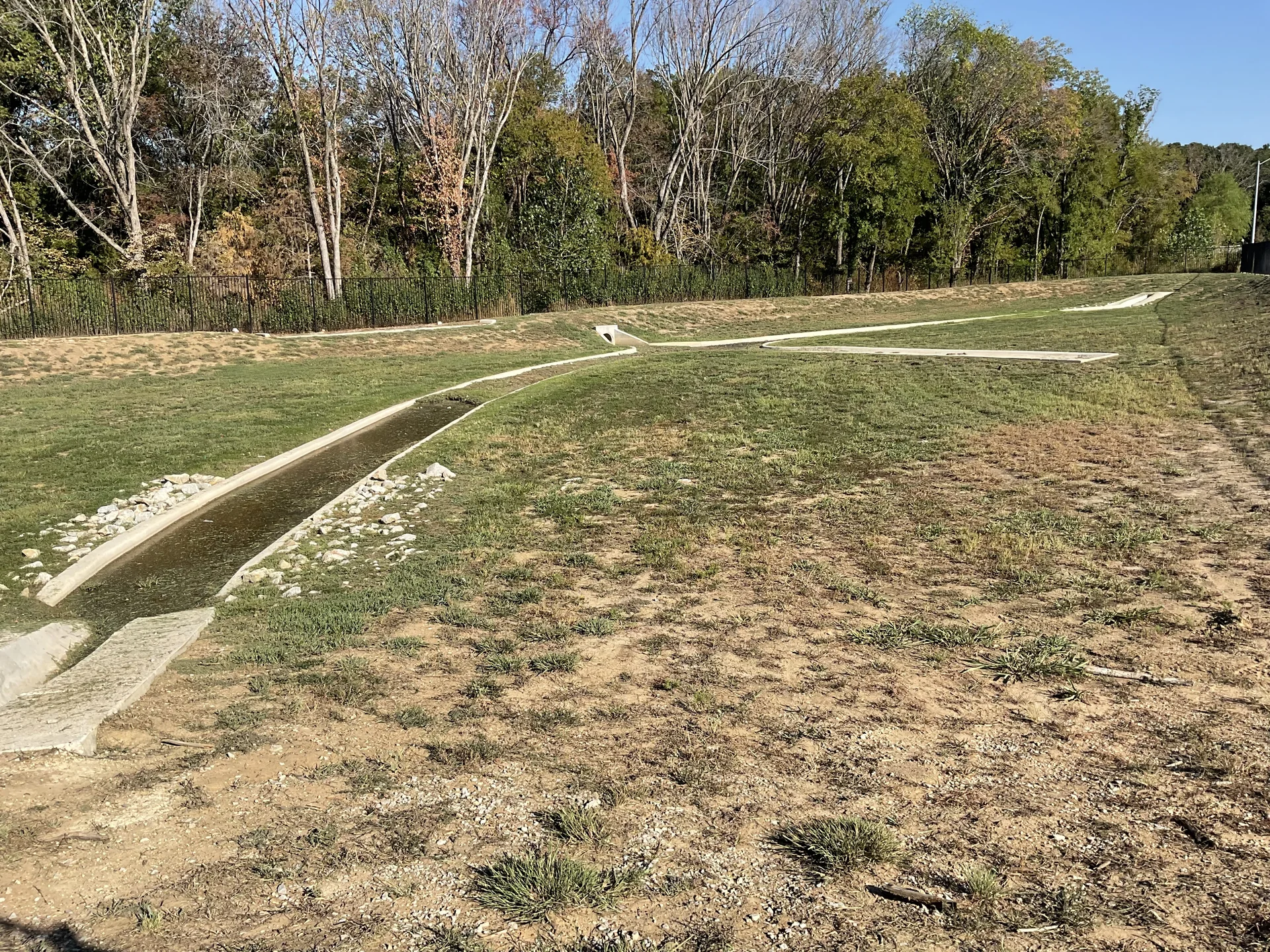
The Filter Sock Myth: Fabric Blinding in Texas Silt
Many hardware store corrugated pipes come pre-wrapped in a knitted polyester “sock.” In theory, this sock keeps dirt out while letting water in. In North Texas, this practice leads to a premature failure mode known as fabric blinding.
Because the fabric sits directly against the pipe perforations, fine clay particles lodge in the fabric pores within 12 to 18 months, creating an impermeable barrier. Water can no longer enter the pipe, and your French drain stops functioning entirely.
The Proper Method: Geotextile Trench Enveloping
The correct engineering practice does not wrap the pipe; it wraps the entire trench:
- Excavate the trench with a minimum 1% slope (1 inch drop per 10 feet).
- Line the bare soil walls and floor with a high-permeability, non-woven 4-ounce needle-punched geotextile fabric.
- Pour a 2-inch bedding layer of clean, washed 1-inch to 1.5-inch round river rock or crushed limestone (free of fines).
- Place rigid perforated PVC pipe with the holes facing downward.
- Backfill with washed stone to within 3–4 inches of the surface.
- Fold the geotextile fabric over the top of the stone envelope like a burrito, overlapping seams by at least 12 inches.
- Top with coarse drainage rock or breathable sod.
This wide envelope distributes silt filtration across several square feet of surface area instead of choking the pipe’s immediate circumference.
Comparison Summary: Corrugated vs. Rigid PVC
- Flow Velocity & Self-Cleaning: Corrugated is poor (sediment collects in ridges). Rigid PVC is superior (smooth walls maintain self-flushing velocity).
- Crush Resistance: Corrugated is low (deforms easily under saturated clay load). Rigid PVC is high (SDR 35 and Schedule 40 retain shape under extreme weight).
- Cleanability: Corrugated cannot be snaked or hydro-jetted without tearing. Rigid PVC can be fully cleared via standard cleanout risers.
- Lifespan in Texas Clay: Corrugated averages 2 to 5 years. Rigid PVC lasts 30 to 50+ years.
- Overall Value: While corrugated pipe costs 20–30% less in raw materials upfront, premature failure requires a complete re-excavation. Rigid PVC delivers permanent property protection.
Protect Your Home with Engineered Drainage
A properly installed French drain or downspout redirection system protects your home’s most expensive asset: its foundation. Settling for cheap corrugated tubing in North Texas clay is a gamble that rarely pays off.
Dealing with standing water or foundation moisture concerns in Dallas, Fort Worth, or surrounding communities? Contact Groundhogs Services today for a comprehensive yard drainage evaluation and engineered PVC installation.