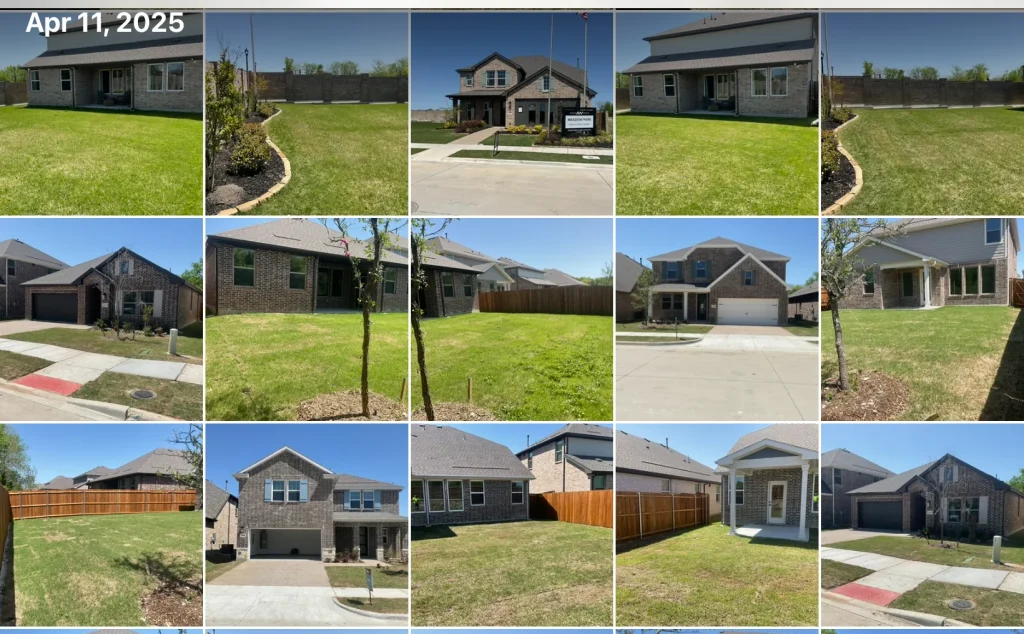
More and more DFW homeowners are asking the same question: “Can I have a beautiful lawn without synthetic chemicals?” The answer is yes — but it takes a different approach than conventional lawn care. At Groundhogs Services, we’ve helped homeowners across Mesquite, Dallas, and Garland transition to organic lawn care with outstanding results. Here’s your complete guide to going chemical-free in North Texas.
Why Go Organic in DFW?
The case for organic lawn care goes beyond environmental concerns. In our region, organic practices actually produce more resilient lawns that handle our extreme climate better:
- Deeper root systems — Organic lawns develop roots 6-8 inches deep vs. 2-3 inches for chemically-fed lawns. This means better drought tolerance during our 100°F summers.
- Improved clay soil structure — Organic matter breaks up our heavy clay, improving drainage and reducing compaction.
- Beneficial soil biology — A healthy soil food web suppresses disease and helps grass access nutrients naturally.
- Safer for kids and pets — No synthetic pesticides or quick-release nitrogen means your family can play on the lawn immediately after treatment.
- Lower long-term costs — Once your soil is healthy, you’ll need fewer inputs and less water.
The Foundation: Soil Health
Organic lawn care starts underground. Before you apply anything, you need to know what you’re working with.
Soil Testing
This is non-negotiable. A soil test tells you your pH, nutrient levels, and organic matter content. In DFW, our clay soil is typically alkaline (pH 7.2-8.0) and low in organic matter.
How to test:
- Texas A&M Soil Lab — The gold standard. Order a kit online, mail in your sample, and get results in 2-3 weeks. Cost is about $20.
- Local extension office — Dallas County AgriLife Extension offers testing services.
- Home test kits — Less accurate but better than nothing. Test for pH at minimum.
What you’re looking for:
- pH: 6.0-7.0 — Most Texas turfgrasses prefer slightly acidic soil. If your pH is above 7.5, you’ll need sulfur to lower it.
- Organic matter: 3-5% — Most DFW lawns have 1-2%. Building organic matter is the single best thing you can do.
- Phosphorus and potassium — These should be in the medium to high range. Most DFW soil has adequate phosphorus but may need potassium.
Compost Topdressing: The Single Best Organic Practice
If you do only one thing for your lawn, make it compost topdressing. It’s the closest thing to a miracle cure in organic lawn care.
What it is: Spreading 1/4 to 1/2 inch of fine, screened compost over your lawn and working it into the soil with a rake or core aeration.
Benefits:
- Adds organic matter directly to the soil
- Introduces beneficial microbes that compete with disease pathogens
- Provides a slow, steady release of nutrients
- Improves water infiltration in clay soil
- Reduces thatch buildup naturally
When to apply in DFW:
- Spring: March-April — After the last freeze, before summer heat
- Fall: September-October — The ideal time. Cooler weather and fall rains help the compost integrate
Where to buy compost in DFW:
- Texas Pure Products (multiple locations) — Their “Enriched Topdressing” blend is excellent for lawns
- Living Earth (Dallas) — High-quality organic compost and soil blends
- City of Dallas Mulch Facility — Free compost for Dallas residents (quality varies)
Application rate: 1 cubic yard covers approximately 1,000 square feet at 1/4 inch depth. Rent a compost spreader or use a shovel and rake for small lawns.
Organic Fertilizers: What Works in Texas
Not all organic fertilizers are created equal. Here’s what performs best in our climate:
Corn Gluten Meal
A natural pre-emergent herbicide that also provides 9-10% nitrogen. It suppresses crabgrass and other annual weeds while feeding the lawn.
- Application rate: 20 pounds per 1,000 square feet
- Timing: Apply March 1-15 and again September 1-15
- Pros: Dual-purpose (weed control + fertilizer), safe for all grass types
- Cons: Less effective than synthetic pre-emergents, can attract ants if not watered in
Milorganite
A slow-release nitrogen fertilizer made from treated biosolids. It’s been used on golf courses and lawns for nearly 100 years.
- Application rate: 15-20 pounds per 1,000 square feet
- Timing: Memorial Day, July 4th, and Labor Day
- Pros: Won’t burn, contains iron for deep green color, slow-release (6-8 weeks)
- Cons: Distinct odor for 24-48 hours after application, relatively expensive
Alfalfa Meal
A balanced organic fertilizer (3-1-2 NPK) that also contains triacontanol, a natural growth stimulant.
- Application rate: 15-20 pounds per 1,000 square feet
- Timing: Spring and fall
- Pros: Excellent soil conditioner, promotes microbial activity
- Cons: Can attract deer and rabbits
Liquid Seaweed (Kelp)
Not a complete fertilizer but an excellent supplement. Contains trace minerals, growth hormones, and stress reducers.
- Application rate: Follow label directions (typically 2-4 oz per gallon)
- Timing: Monthly during growing season
- Pros: Improves heat and drought tolerance, reduces transplant shock
- Cons: Must be applied frequently, not a primary nutrient source
Natural Weed Control
Organic weed control requires a different mindset. You’re managing weeds, not eliminating them entirely.
Corn Gluten Meal (Pre-Emergent)
As mentioned above, corn gluten meal prevents weed seeds from germinating. It’s about 60-70% as effective as synthetic pre-emergents but completely safe. Apply at the same timing as synthetic pre-emergents: February 15-March 15 and September 1-October 1.
Vinegar-Based Herbicides (Post-Emergent)
Household vinegar (5% acetic acid) is too weak for most weeds. You need 20% horticultural vinegar for effective control.
- Best for: Young broadleaf weeds in beds and cracks
- Application: Spray on a sunny day when temperatures are above 80°F
- Limitations: Kills grass on contact, so spot-treat only. Not effective on established perennial weeds with deep taproots.
Hand Pulling + Proper Mowing
For small lawns, hand pulling after rain is the most effective organic weed control. Combine with proper mowing height (3-4 inches for St. Augustine, 2-3 inches for Bermuda) to shade out weed seeds.
Transitioning from Conventional to Organic
If you’ve been using synthetic fertilizers and herbicides, don’t go cold turkey. Your lawn will go through a “detox” period as the soil biology adjusts.
The 2-Year Transition Plan:
Year 1:
- Stop using synthetic herbicides and pesticides
- Switch to slow-release organic fertilizers
- Apply compost topdressing in spring and fall
- Expect some weed pressure as the soil adjusts
Year 2:
- Soil biology should be established
- Weed pressure will decrease naturally
- Lawn will be more drought and disease tolerant
- You can reduce fertilizer rates
When to Call Groundhogs Services
Transitioning to organic lawn care takes knowledge and patience. If you want professional results without the trial and error, Groundhogs Services offers organic lawn care programs for DFW homeowners. We handle soil testing, compost application, organic fertilization, and natural weed control.
Ready to go organic? Call us at (214) 713-1228 or visit groundhogstx.com to schedule your consultation. We serve Mesquite, Dallas, Garland, Rockwall, and the entire DFW metroplex.