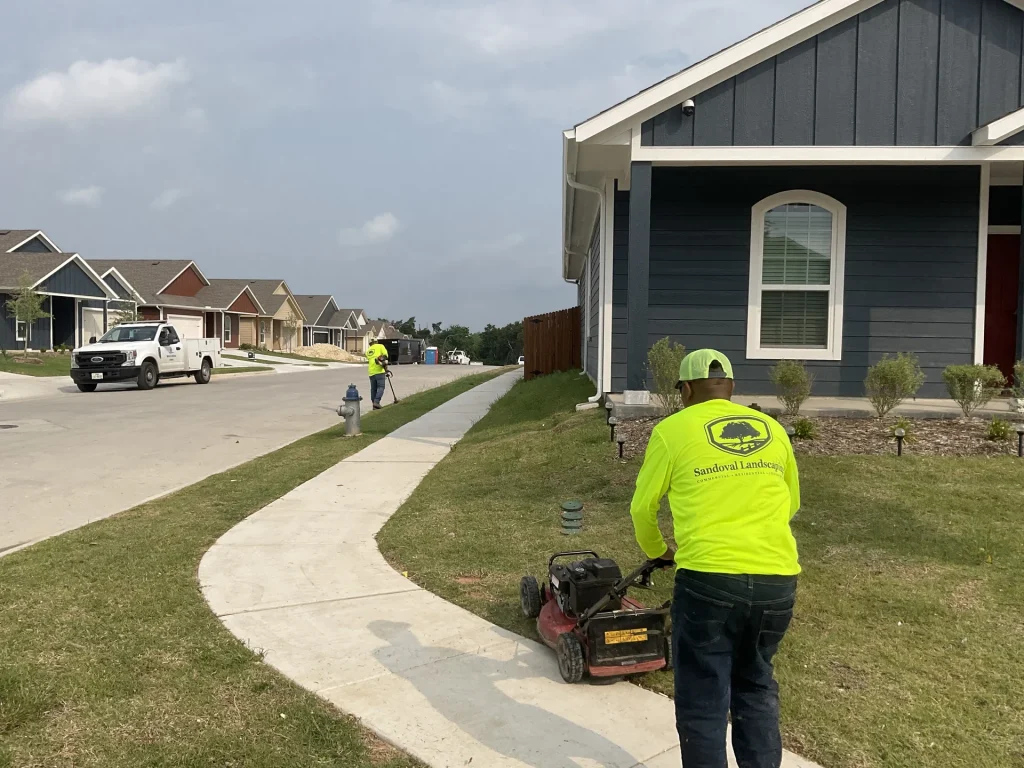
You’d think mowing the lawn is simple — fire up the mower, push it around, done. But in North Texas, the difference between a lawn that thrives and one that struggles often comes down to how you mow. At Groundhogs Services, we’ve maintained thousands of lawns across Mesquite, Dallas, and Garland, and we’ve seen every mowing mistake in the book. Here’s the definitive guide to mowing your DFW lawn like a pro.
Why Mowing Height Matters More Than You Think
Your grass is a living plant, and every time you mow, you’re wounding it. The height you cut at determines how well it recovers and how deeply it roots.
The fundamental rule: Never remove more than one-third of the leaf blade in a single mowing. This is called the one-third rule, and violating it is the #1 cause of stressed, thin lawns in DFW.
When you cut off more than one-third:
- The grass goes into shock and stops growing roots
- The remaining leaf surface can’t photosynthesize enough energy
- Weeds move in to fill the gaps
- The lawn becomes vulnerable to disease and drought
Mowing Heights by Grass Type
DFW is a transition zone, meaning we grow both warm-season and cool-season grasses. Each has different requirements.
Bermuda Grass
The most common grass in DFW for full-sun lawns. It’s aggressive, durable, and recovers quickly.
- Optimal height: 1 to 2 inches
- Sports fields and high-traffic areas: 0.5 to 1 inch (requires a reel mower)
- Mowing frequency: Every 3-5 days during peak growing season (May-September)
- Scalping: Bermuda should be scalped (cut to 0.5-1 inch) in late February or early March to remove dead winter growth and encourage early green-up
Pro tip: Bermuda is the only common DFW grass that benefits from scalping. Don’t scalp St. Augustine or Zoysia — you’ll damage the stolons.
St. Augustine Grass
The most shade-tolerant warm-season grass, common in established DFW neighborhoods with mature trees.
- Optimal height: 2.5 to 4 inches
- Mowing frequency: Every 7-10 days during growing season
- Never scalp: St. Augustine spreads via above-ground stolons. Cutting too low damages these runners and creates bare spots that fill with weeds.
- Summer height: Keep it at 3.5-4 inches during July and August for better heat and drought tolerance
Critical: St. Augustine should never be mowed below 2.5 inches. If you see brown stolons after mowing, you’re cutting too low.
Zoysia Grass
A slow-growing, dense grass that’s gaining popularity in DFW for its drought tolerance and soft texture.
- Optimal height: 1 to 2 inches
- Mowing frequency: Every 7-14 days (slower growing than Bermuda)
- Best mower: Reel mower produces the cleanest cut for Zoysia’s tough leaf blades
- Summer height: 2 inches during peak heat
Tall Fescue
A cool-season grass used in DFW for shady lawns where warm-season grasses won’t grow.
- Optimal height: 3 to 4 inches
- Mowing frequency: Every 5-7 days in spring and fall, every 10-14 days in summer
- Summer stress: Raise to 4 inches during July and August to protect the crown from heat
- Never scalp: Fescue doesn’t go fully dormant in DFW winters, but it should be kept at 3 inches year-round
The One-Third Rule in Practice
Let’s say you have Bermuda grass at 2 inches and it’s been growing for a week. If it’s now 3 inches tall, you can safely cut it to 2 inches (removing 1/3 of the leaf blade).
But what if you went on vacation and it’s now 5 inches tall? You can’t cut it to 2 inches in one pass — that’s removing 60% of the leaf. Instead:
- Cut to 3.5 inches
- Wait 3-4 days
- Cut to 2.5 inches
- Wait 3-4 days
- Cut to 2 inches
This gradual reduction keeps the grass healthy and avoids shock.
Sharp Blades: The Overlooked Essential
A dull mower blade tears grass instead of cutting it. Torn grass blades have ragged edges that turn brown within 24 hours, giving your lawn a tan, stressed appearance. More importantly, torn tissue is an open wound that disease pathogens can enter.
How often to sharpen:
- Residential lawns: Every 10-15 hours of use (about every 4-6 weeks during growing season)
- Commercial/professional: Every 8-10 hours
- Signs you need to sharpen: Grass tips look frayed or whitish after mowing, or the mower vibrates excessively
DIY sharpening: Remove the blade, clamp it in a vise, and file at the original bevel angle (typically 30-45 degrees). Balance the blade on a screwdriver before reinstalling — if one side is heavier, file more off the heavy side.
Mowing Patterns: More Than Just Looks
Alternating your mowing pattern prevents soil compaction and ruts. Grass blades naturally lean in the direction you mow. If you always mow the same direction, the grass develops a permanent lean and the soil compacts along your wheel tracks.
The pattern rotation:
- Week 1: North-South
- Week 2: East-West
- Week 3: Diagonal (NE-SW)
- Week 4: Diagonal (NW-SE)
- Repeat
This also produces the classic striped lawn look that makes your yard stand out in the neighborhood.
Seasonal Adjustments for DFW
Spring (March-May)
- Bermuda: Lower to 1-1.5 inches for the first 2-3 mowings to remove dead winter material, then raise to 2 inches
- St. Augustine: Start at 3 inches, raise to 3.5 inches by May
- Frequency: Increase as growth accelerates — you may need to mow every 4-5 days by May
Summer (June-August)
- All grass types: Raise mowing height by 0.5-1 inch above spring height
- Why: Taller grass shades the soil, reducing water evaporation and keeping roots cooler. A 4-inch St. Augustine lawn can survive 2 weeks without water; a 2-inch lawn will die in 5 days.
- Frequency: May slow to every 7-10 days as heat stress reduces growth
Fall (September-November)
- Bermuda and Zoysia: Lower back to spring height as temperatures cool
- St. Augustine: Keep at 3-3.5 inches
- Frequency: Gradually reduce as growth slows
- Last mowing: Bermuda should be at 1.5-2 inches going into winter to reduce disease pressure
Winter (December-February)
- Bermuda and Zoysia: Dormant — no mowing needed
- St. Augustine: May need occasional mowing if we have a warm winter
- Fescue: Mow at 3 inches every 2-3 weeks if actively growing
Mulching vs. Bagging
Mulching (leaving clippings on the lawn) returns nitrogen and organic matter to the soil. Clippings are 80% water and 4% nitrogen — they decompose quickly and feed the lawn. Always mulch unless:
- The grass is wet (clumps will smother the lawn)
- You’re cutting more than 1/3 of the blade (excess clippings)
- You’re treating a disease outbreak (remove infected clippings)
- You’re preparing for a fungicide application (remove debris for better coverage)
Bagging is necessary for the situations above, but it removes nutrients that you’ll have to replace with fertilizer.
When to Call Groundhogs Services
If you’re tired of spending your weekends behind a mower or you want professional results without the equipment investment, Groundhogs Services offers comprehensive lawn maintenance programs for DFW homeowners. We handle mowing, edging, trimming, and blowing — on schedule, every time.
Call us at (214) 713-1228 or visit groundhogstx.com to get a free quote. We serve Mesquite, Dallas, Garland, Rockwall, and the entire DFW metroplex.