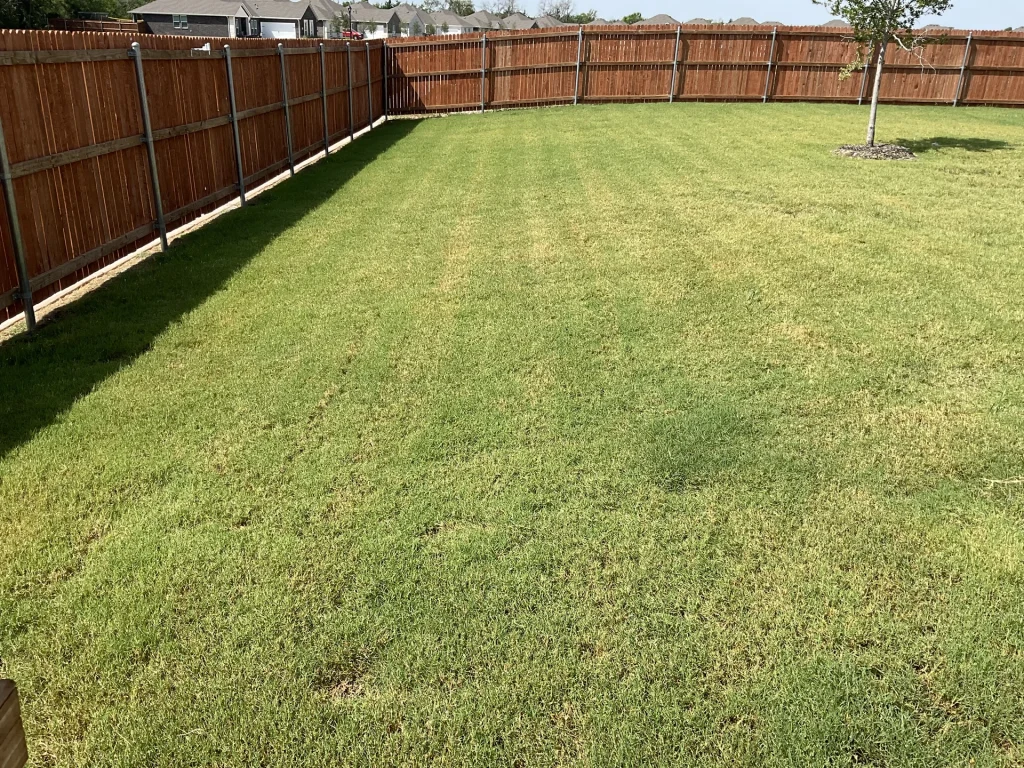
A lush, green lawn is a point of pride in North Texas. But achieving that golf-course look requires more than just water and mowing. DFW’s clay soil, intense heat, and distinct growing seasons demand a strategic fertilization program tailored to your grass type.
At Groundhogs Services, we’ve managed lawns across Mesquite, Dallas, Garland, and the DFW metroplex for years. Here’s our complete guide to fertilizing like a pro.
Know Your Grass Type
DFW is a “transition zone” — warm-season grasses dominate, but cool-season varieties can work with proper care.
Bermuda Grass
The most common lawn grass in DFW. Aggressive grower, high traffic tolerance, full sun required.
Fertilization needs: High. Bermuda is a heavy feeder that responds well to nitrogen.
St. Augustine
Second most common in DFW. Shade-tolerant, thick blades, soft underfoot.
Fertilization needs: Moderate. St. Augustine is sensitive to over-fertilization, especially nitrogen in summer.
Zoysia
Growing in popularity. Dense, slow-growing, handles partial shade.
Fertilization needs: Low to moderate. Zoysia needs less nitrogen than Bermuda but more than St. Augustine.
N-P-K Explained (Simplified)
Every fertilizer bag has three numbers: N-P-K (Nitrogen-Phosphorus-Potassium).
- Nitrogen (N) — Drives green growth and leaf development. The most important number for lawns.
- Phosphorus (P) — Promotes root growth. Less critical for established lawns. Banned in some DFW cities (Dallas restricts P use).
- Potassium (K) — Strengthens cell walls, improves drought tolerance, and helps grass handle Texas heat.
For DFW lawns: Use a high-nitrogen, low-phosphorus formula. A 15-0-10 or 21-0-10 is ideal for most applications.
Soil Testing: Start Here
Before you buy a single bag of fertilizer, test your soil. The Texas A&M AgriLife Extension offers soil testing for $15-$25 per sample.
What a soil test tells you:
- pH level (DFW clay is typically 7.0-8.0 — alkaline)
- Nutrient levels (N, P, K, plus micronutrients)
- Organic matter content
- Cation exchange capacity (how well your soil holds nutrients)
How to take a sample:
- Use a clean trowel or soil probe
- Take 6-8 samples from different areas of your lawn
- Mix them together in a clean bucket
- Remove grass, roots, and rocks
- Dry 1 cup of the mixed sample
- Bag it and mail to the Texas A&M Soil Testing Lab
DFW note: Most DFW lawns test high in phosphorus and potassium. You may only need nitrogen. Don’t guess — test.
Seasonal Fertilization Schedule
Spring (March-April)
Goal: Wake up the lawn, promote root growth, apply pre-emergent.
- Late February to early March: Apply pre-emergent herbicide (Dimension or Barricade) to prevent crabgrass. Do NOT apply fertilizer yet — the grass isn’t actively growing.
- Mid-March to early April: First nitrogen application. Use a slow-release formula (21-0-10 or similar) at 0.5-0.75 lbs of nitrogen per 1,000 sq ft.
- Soil temperature: Apply when soil temps reach 55°F consistently (check the Texas A&M soil temperature map).
Bermuda: Apply 0.5 lbs N/1,000 sq ft
St. Augustine: Apply 0.3 lbs N/1,000 sq ft (half rate)
Zoysia: Apply 0.3 lbs N/1,000 sq ft
Late Spring (May)
Goal: Support rapid growth as temperatures climb.
- Mid-May: Second nitrogen application. Same rate as spring.
- Iron supplement: Apply liquid iron (chelated iron) for deep green color without stimulating excessive growth.
Bermuda: Apply 0.75 lbs N/1,000 sq ft
St. Augustine: Apply 0.5 lbs N/1,000 sq ft
Zoysia: Apply 0.5 lbs N/1,000 sq ft
Summer (June-August)
Goal: Maintain color and health during heat stress. Do NOT over-fertilize.
- June: Third application. Use a formula with potassium (e.g., 15-0-15) to support heat tolerance.
- July-August: Pause fertilization during peak heat. St. Augustine is especially sensitive to summer nitrogen — it can trigger large patch fungus.
Bermuda: Apply 0.5 lbs N/1,000 sq ft in June only
St. Augustine: Skip summer fertilization
Zoysia: Apply 0.3 lbs N/1,000 sq ft in June only
Fall (September-October)
Goal: Prepare for winter dormancy. Build root reserves.
- September: Fourth application. Use a balanced or slightly higher potassium formula (e.g., 15-0-15 or 10-0-20).
- October: Apply a “winterizer” — high-potassium, low-nitrogen formula. This helps the lawn survive winter and green up faster in spring.
Bermuda: Apply 0.5 lbs N/1,000 sq ft in September, skip winterizer
St. Augustine: Apply 0.3 lbs N/1,000 sq ft in September, skip winterizer
Zoysia: Apply 0.3 lbs N/1,000 sq ft in September, winterizer in October
Winter (November-February)
Goal: Rest. Do not fertilize.
Organic vs. Synthetic Fertilizers
Synthetic Fertilizers
Fast-acting, precise nutrient ratios, affordable.
Pros: Immediate results, consistent analysis, less expensive per pound of nitrogen
Cons: Can burn grass if over-applied, doesn’t improve soil biology, can leach into groundwater
Best for: Quick green-up, established lawns, precise feeding schedules
Organic Fertilizers
Slow-release, soil-building, environmentally friendly.
Pros: Feeds soil microbes, slow release (won’t burn), improves soil structure, reduces thatch
Cons: Slower results, more expensive per pound of nitrogen, variable analysis, can attract pests
Best for: Building long-term soil health, lawns with heavy clay, environmentally conscious homeowners
Our recommendation: Use a hybrid approach. Apply synthetic slow-release in spring and fall for predictable results, and top-dress with compost or organic fertilizer annually to build soil health.
Application Tips for DFW Lawns
- Use a spreader — Drop spreaders are more precise than broadcast spreaders. Calibrate your spreader annually.
- Water it in — Apply fertilizer when rain is expected within 24 hours, or water immediately after application. Dry fertilizer sitting on leaves burns the grass.
- Don’t apply before heavy rain — Fertilizer runoff is wasteful and pollutes local waterways. Check the forecast.
- Split applications — Multiple small applications are better than one large one. Grass can only use so much nitrogen at once.
- Watch the temperature — Don’t apply when temps exceed 95°F. Fertilizer stress + heat stress = dead grass.
Common DFW Fertilization Mistakes
- Over-fertilizing St. Augustine — Causes large patch fungus, thatch buildup, and winter kill
- Skipping soil tests — You’re guessing, and you’re probably wrong
- Applying too early — Fertilizer before the grass is actively growing feeds weeds
- Using high-phosphorus formulas — Dallas restricts P use, and most DFW soil already has plenty
- Ignoring potassium — Potassium is critical for heat and drought tolerance in Texas
Ready for a Professional Lawn Program?
Managing a DFW lawn takes knowledge, timing, and the right products. Groundhogs Services offers custom fertilization programs tailored to your grass type, soil conditions, and schedule. We handle the testing, the applications, and the follow-up.
Call (214) 713-1228 or visit groundhogstx.com to schedule a consultation. Let’s make your lawn the best on the block.